According to the latest data, the global cybersecurity workforce is made up of approximately 5.5 million people.
However, that may not be enough to meet the cybersecurity challenges of tomorrow.
Below, we’ll explore the scale and scope of the problem across regions, industries, and experience levels.
- Top Cybersecurity Talent & Workforce Shortage Statistics
- Global Cybersecurity Workforce Gaps
- United States Cybersecurity Talent Gap
- Regional Cybersecurity Workforce Gaps
- Cybersecurity Employer Perspectives
- Cybersecurity Employee Perspectives
- Gender & Diversity Representation
- Age & Entry-Level Opportunities
- Hiring Timelines & Employer Strategies
Top Cybersecurity Talent & Workforce Shortage Statistics
- There are approximately 4.8 million cybersecurity-related vacancies globally.
- The cybersecurity workforce needs to increase by 87% to satisfy current demand.
- Asia-Pacific has the largest cybersecurity workforce gap (3.4 million).
- The US has a cybersecurity workforce gap of over half a million.
- 9 in 10 hiring managers would consider candidates with only previous IT experience.
- Around half of all organizations take more than 6 months to fill a cybersecurity vacancy.
Global Cybersecurity Workforce Gaps
The cybersecurity workforce gap is increasing rapidly. According to the latest available data, the world needs an additional 4.8 million cybersecurity professionals to meet current needs.
In the space of two years, that figure has shot up by more than 40%.
That means that the cybersecurity workforce must increase by 87% to meet global demand.
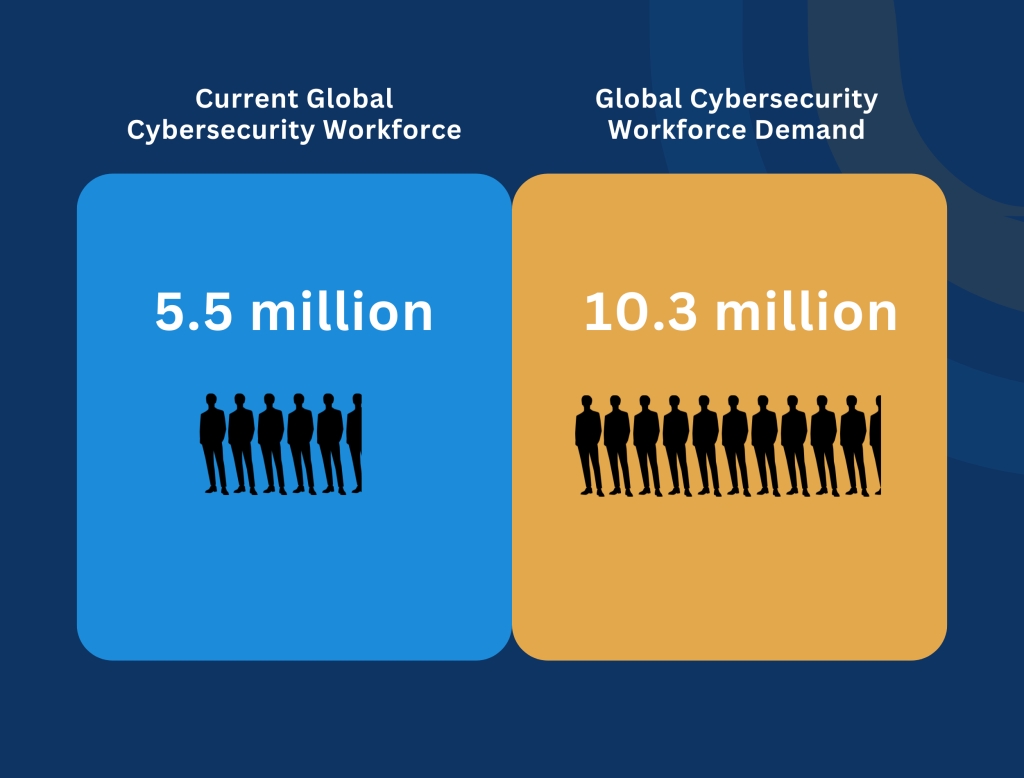
Cybersecurity teams are facing persistent recruitment challenges, with 67% of organizations short on staff, just a 2% dip since 2022.

In total, just four industries make up 64% of the shortage:
- Financial Services
- Materials and Industrial
- Consumer Goods
- Technology
Looking at the wider picture, it is predicted that by 2030, there may be a worldwide talent shortage of over 85 million people, a statistic that could have a direct impact on the cybersecurity industry.
Sources: ISC2, Computer Weekly, BCG, World Economic Forum
United States Cybersecurity Talent Gap
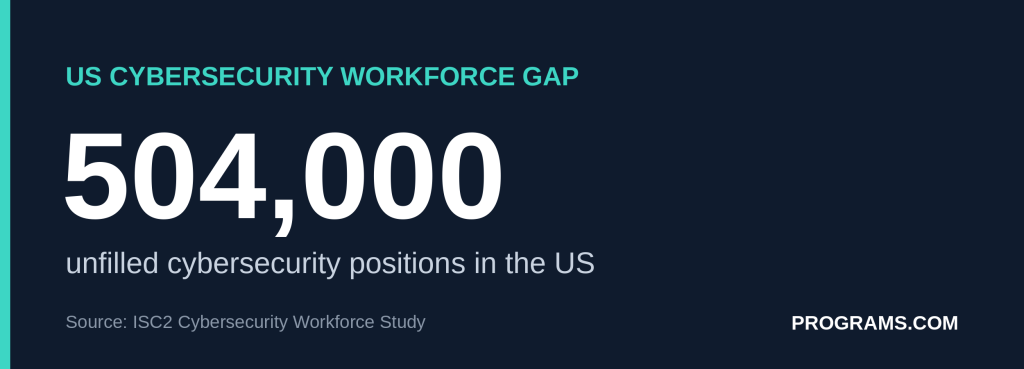
According to the latest available data, the US faces a cybersecurity workforce gap of approximately 504,000 unfilled positions.
One major way to help close the talent gap is by encouraging more individuals to pursue formal education and training in cybersecurity, whether through cybersecurity degree programs or industry-recognized certifications that build in-demand skills.
This shortage spans multiple roles, including:
- Security analysts
- Engineers
- Penetration testers
- Incident responders
The fact that these specific roles are short of talent shows there’s a growing demand for professionals capable of protecting critical infrastructure, government systems, and private sector networks.
The cybersecurity talent gap in the US remains one of the largest in the world.
There has been steady growth in training programs, certifications, and university degree offerings, ranging from associate’s and bachelor’s to master’s and PhD programs. Despite this, demand for talent continues to outpace supply.
Industry reports note that the shortfall is especially pronounced in sectors such as healthcare, finance, and government, where regulatory requirements and the sensitivity of data create heightened security needs.
If current trends continue, the US will need not only to expand the pipeline of new entrants into the field, often through online cybersecurity bachelor’s programs, but also to invest in upskilling existing IT professionals through options like online master’s degree programs in cybersecurity to meet rising security demands.
Source: ISC2
Regional Cybersecurity Workforce Gaps
Asia-Pacific has the largest regional workforce gap at approximately 3.4 million people. That figure represents a significant increase from 2.7 million a year earlier.

In terms of individual countries, China currently has the largest cybersecurity workforce gap (2 million+). This is followed by India, with over 1 million cybersecurity vacancies.
South Korea has seen the biggest annual increase in the cybersecurity workforce gap, almost doubling from around 18,000 to approximately 31,000.
Meanwhile, Brazil has seen a 7.5% decrease in the cybersecurity workforce gap, bringing down Latin America’s total by 5.7%.

This is the cybersecurity workforce gap by country:
| Country | Region | 2024 Workforce Gap | Change Over Previous Year |
| China | Asia-Pacific | 2.048 million | ↑ 19% |
| India | Asia-Pacific | 1.074 million | ↑ 35.9% |
| US | North America | 504k | ↑ 4.4% |
| Brazil | Latin America | 215k | ↓ 7.5% |
| Japan | Asia-Pacific | 170k | ↑ 53.8% |
| Germany | Europe | 120k | ↑ 15% |
| Mexico | Latin America | 114k | ↓ 2.1% |
| UK | Europe | 93k | ↑ 27.1% |
| Spain | Europe | 73k | ↓ 1.7% |
| France | Europe | 69k | ↑ 17% |
| South Africa | Middle East & Africa | 63k | ↑ 10.1% |
| Australia | Asia-Pacific | 48k | ↑ 71.3% |
| Canada | North America | 38k | ↓ 1.2% |
| UAE | Middle East & Africa | 35k | ↑ 9.7% |
| South Korea | Asia-Pacific | 31k | ↑ 77.9% |
| Netherlands | Europe | 29k | ↓ 1.6% |
| Saudi Arabia | Middle East & Africa | 18k | ↑ 26.8% |
| Nigeria | Middle East & Africa | 9k | ↑ 5.7% |
| Ireland | Europe | 8k | ↑ 9.2% |
| Singapore | Asia-Pacific | 5k | ↑ 17.7% |
There are only 20,000 certified cybersecurity professionals in Africa.
Emerging markets demand more talent growth, yet the concern spreads beyond developing nations.
Almost half (43%) of small to medium-sized UK companies aren’t in a position to employ cybersecurity support.
Sources: ISC2, Worldometers, World Economic Forum, IMD
Cybersecurity Employer Perspectives
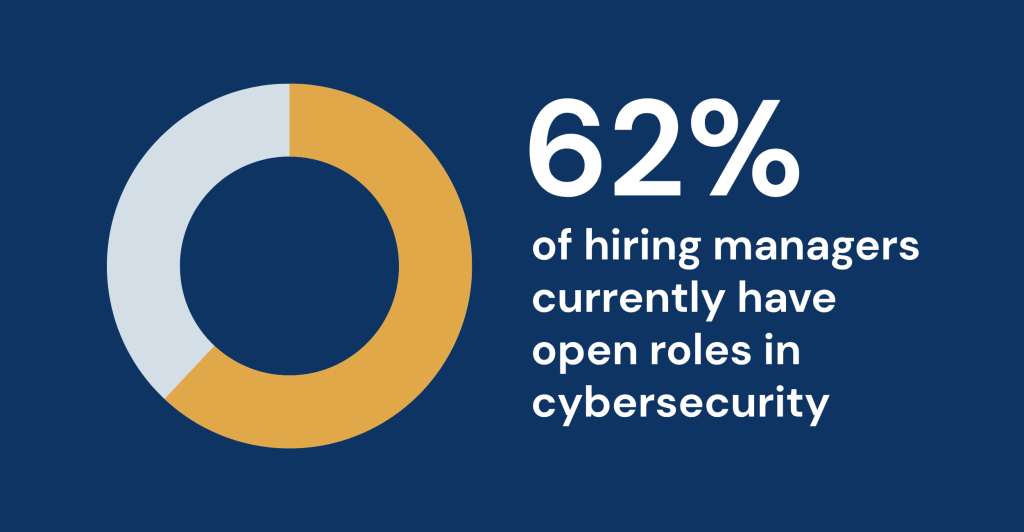
As many as 62% of hiring managers currently have open cybersecurity roles. Yet many are finding these vacancies difficult to fill.
That’s despite most security managers being open to career changers, with 90% willing to consider candidates with only previous IT work experience and 89% willing to consider those with only an entry-level cybersecurity certification.
Nonetheless, most (58%) of recruiters are worried about attrition in their security team.
Some of the reasons that cybersecurity pros are leaving their roles include:
- Recruited by other companies – 59%
- Poor financial incentives (salaries or bonuses) – 48%
- Limited promotion and development opportunities – 47%
- High work stress levels – 45%
- Lack of management support – 34%
One way this is being combated is through training entry and junior-level talent. The majority of hiring managers state that they have sufficient budget for professional development (75%) and enough money to adequately staff their security teams (73%).
Despite this, 39% still attribute cybersecurity shortages to a lack of budget.
Sources: ISC2, ISC2 (2), Professional Security Magazine, ISC2 (3)
Cybersecurity Employee Perspectives
Cybersecurity professionals are facing growing challenges in terms of opportunities.
Around 3 in 4 (74%) say the current threat landscape is the most challenging it has been in the past 5 years.

A quarter (25%) of pros have seen lay-offs within their cybersecurity teams. That’s up 3% in 12 months. While 38% have experienced hiring freezes, an increase of 6% since 2023.
Approximately 1 in 3 (32%) are seeing fewer promotions, also up 6%. This is likely a reason for declining job satisfaction.
Other contributing factors may include:
- Severe work-related stress – 44%
- The perception that cybersecurity is more stressful than other IT jobs – 66%
- Additional challenges related to recent high-profile breaches – 84%
In 2022, 74% of cybersecurity pros were satisfied with their jobs. This figure dropped to 70% in 2023 and has since fallen a further 4% to 66% as of 2024.
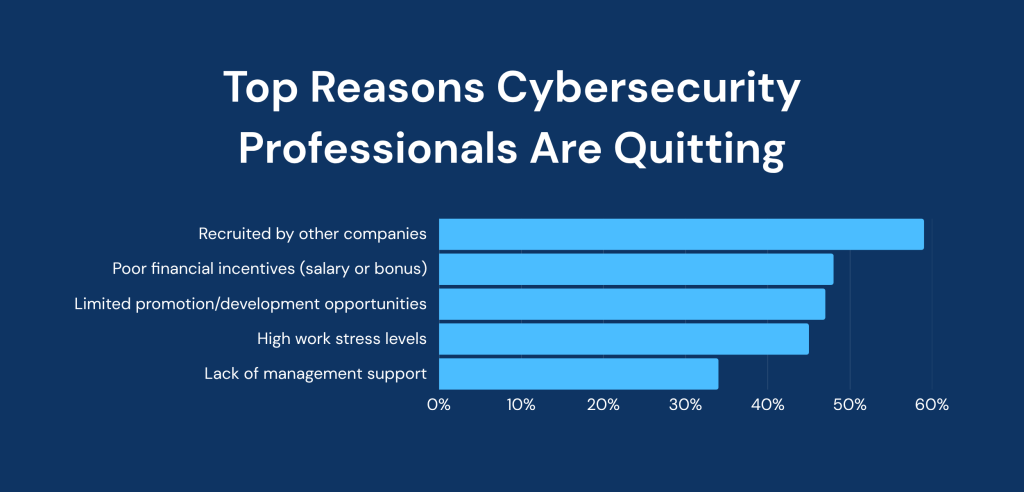
Here are some of the top reasons cybersecurity professionals quit their jobs:
| Rank | Reason | Proportion |
| 1 | Recruited by other companies | 59% |
| 2 | Poor financial incentives (salary or bonus) | 48% |
| 3 | Limited promotion/development opportunities | 47% |
| 4 | High work stress levels | 45% |
| 5 | Lack of management support | 34% |
Sources: ISC2, ISC2 (2), Cornell University
Age & Entry-Level Opportunities
Organizations worldwide continue to struggle to secure foundational talent.
Only 69% of organizations have entry-level cybersecurity professionals on their team.
This issue is even more pronounced in smaller companies (500 employees and under), where just 64% offer entry-level positions, and 79% have places for junior-level professionals.
As a result, the average cybersecurity professional is approximately 42.2 years old.

Here’s how that compares to other similar jobs in the technology space:
| Job | Average Age |
| Computer and information systems managers | 47 |
| Network and computer systems administrators | 45.4 |
| Cybersecurity specialist | 42.2 |
| Computer programmer | 42 |
| Computer support specialists | 41.7 |
| Computer systems analysts | 41 |
| Software quality assurance analysts and testers | 40.6 |
| Information security analysts | 40.5 |
Sources: Zippia, Bureau of Labor Statistics
Hiring Timelines & Employer Strategies
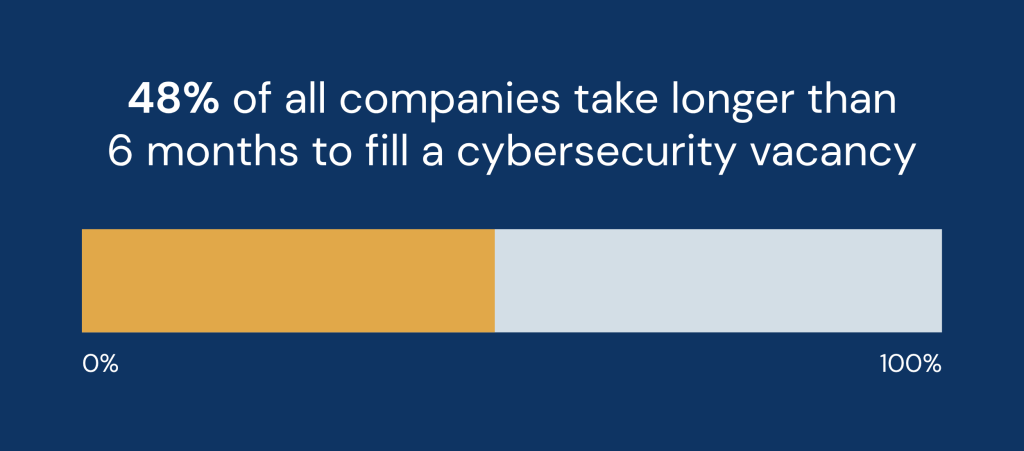
Almost half (48%) of all companies take over 6 months to fill a cybersecurity vacancy.
The seniority of the role plays a large part in this. For nearly 1 in 3 (36%) of organizations, it can take a year or more to hire a senior-level professional. In contrast, junior-level roles are filled in as little as one to three months 42% of the time.
When identifying possible candidates, hiring managers are searching for:
- Hands-on cybersecurity experience – 73%
- Cybersecurity credentials – 36%
- Hands-on training – 25%
However, hiring new talent is rarely the preferred option – 85% of employers would rather upskill existing staff. And 69% of hiring managers favor candidates who’ve recently upskilled or gained certifications.
In fact, 65% of cybersecurity roles now demand ongoing certification updates.
And this approach is backed by the data, with a 70% fall in security-related risks following cybersecurity awareness training.
Sources: Caspersky, Professional Security Magazine, WiFiTalents, Keepnet Labs
Conclusion
The cybersecurity workforce shortage is a global challenge that continues to intensify.
Addressing it will require coordinated efforts across education, training, and hiring practices, especially in entry-level opportunities and underrepresented regions.
Without significant change, the gap may continue to widen, leaving organizations vulnerable and at risk.