The CEH certification, offered by EC-Council, is one of the most recognized entry-to-mid-level cybersecurity credentials.
It’s especially relevant for those looking to validate foundational ethical hacking knowledge for government roles, DoD compliance, or early red team career paths.
Fast Facts: CEH Certification
| Category | Details |
| Cost | $550–$1,199 for exam only; up to $3,499 with training |
| Prep Time | 4–16 weeks, depending on experience |
| Exam Format | 125 multiple-choice questions, 4 hours |
| Job Roles | SOC analyst, pentester, threat hunter, consultant |
| Avg. U.S. Salary for Holders | $125,000 (range: $106K–$180K) |
| Renewal | Every 3 years; 120 CPEs + $240 total fees |
| Experience Recommended | 2 years in InfoSec (or take official training) |
Who Is CEH For?
CEH prepares professionals to transition into offensive cybersecurity roles.
Specifically, this cert provides structure for individuals moving from general IT into security, especially those without prior hands-on hacking experience.
Ideal candidates include:
- SOC analysts looking to upskill
- Network admins transitioning to security
- Early-career cybersecurity professionals working under a mentor
- Defense contractors fulfilling DoD 8570/8140 requirements
It is not well-suited for:
- Complete beginners without networking or OS knowledge
- Experienced red teamers or penetration testers
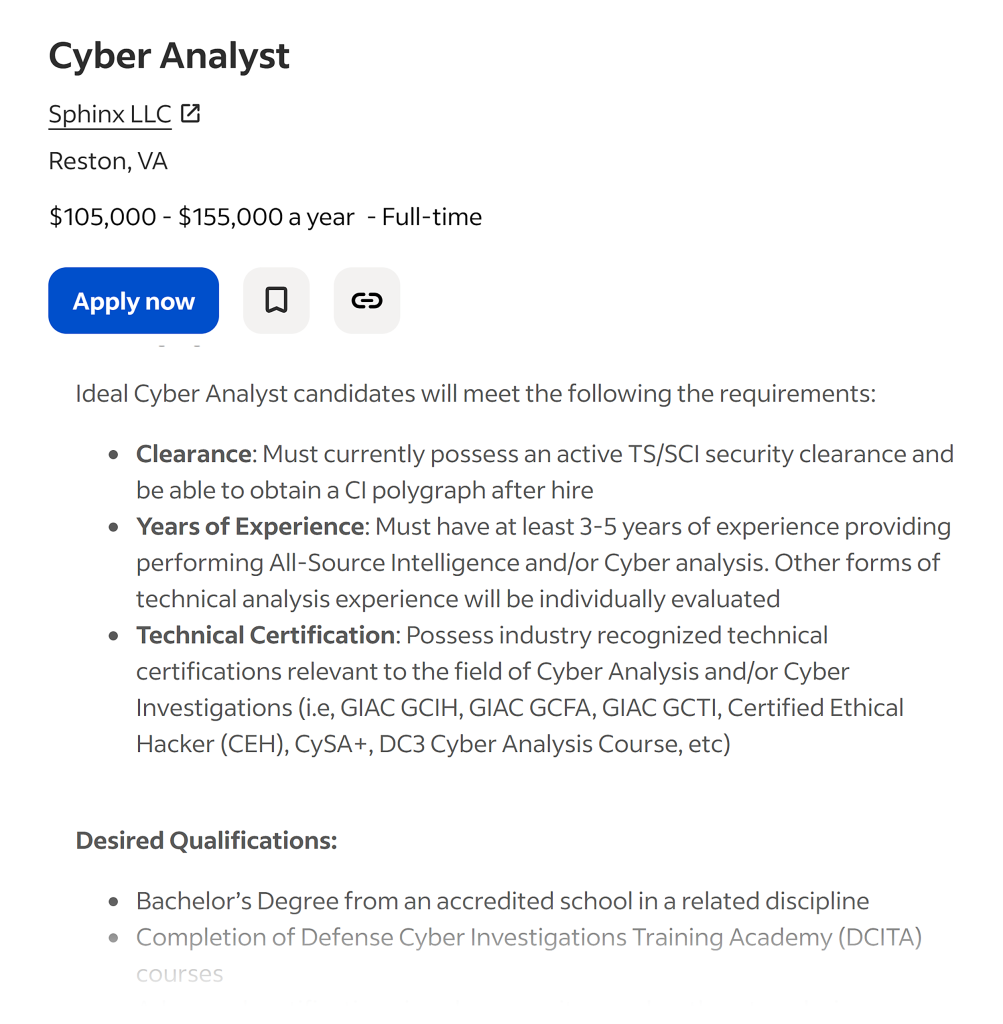
In federal roles, CEH is often mandatory.
For example, this job for a private contractor for national security organizations specifically cites a CEH as a requirement:
In private-sector environments, particularly at fast-moving tech companies, it holds less weight unless reinforced with practical skills.
For example, this job posting for a cybersecurity bootcamp mentor doesn’t cite a specific CEH requirement:

How Much Does CEH Cost?
Exam Voucher Options:
- $550: Remote Proctored
- $950: Online via EC-Council
- $1,199: Pearson VUE testing center
Training Options:
- $850: Self-paced (no voucher)
- $2,999: CEH Unlimited (1-year EC-Council access)
- $3,499: Live EC-Council bootcamp
- $1,500–$5,000: Third-party bootcamps
Ongoing Costs:
- $80/year maintenance fee
- $240 over three years
Total Investment:
- Self-study: around $1,200–$1,300
- Official or bootcamp training: Up to $5,000
As you can see, a CEH cert is not cheap. So it really only makes sense to pursue it if your target role explicitly requires CEH.
CEH Preparation Timeline
| Candidate Type | Estimated Study Time |
| Complete beginner | 12–16 weeks |
| IT pro with security exposure | 4–8 weeks |
| Bootcamp attendee | 1 week full-time |
Recommended Study Stack:
- Book: Matt Walker’s All-in-One CEH Guide
- Labs: TryHackMe (“Pre Security”, “Red Team Path”), Hack The Box (“Starting Point”), EC-Council iLabs
- Practice Tests: Boson CEH Practice Exams
- Video: Jason Dion CEH Course (Udemy)
Sample 8-Week Study Plan (Self-Paced)
Week 1–2: Reconnaissance and footprinting
- Read Matt Walker’s chapters
- Complete TryHackMe’s “Intro to Networking” and “Footprinting” labs
Week 3: Scanning and enumeration
- Practice Nmap scanning on TryHackMe’s “Blue” box
- Learn and test Netcat, enum4linux
Week 4: Vulnerability assessment basics
- Run scans with Nessus Essentials
- Start Hack The Box “Weak” machine
Week 5: Web app and system hacking
- Simulate attacks with Burp Suite and DVWA
- Watch web app hacking walkthroughs
Week 6: Wireless, mobile, and IoT security
- Complete theory modules (limited lab options)
Week 7: Malware, cryptography, and evasion
- Walk through cryptographic attacks in controlled labs
- Analyze simple obfuscation scripts (Python)
Week 8: Practice tests and review
- Take Boson practice exams
- Identify weak areas and revisit key labs
What the CEH Exam Covers (v13)
Major Domains:
- Reconnaissance and footprinting
- Scanning and enumeration
- Web app attacks
- System hacking and malware
- Wireless, IoT, and mobile vulnerabilities
- Cryptographic attacks
Exam Details:
- 125 multiple-choice questions
- 4-hour time limit
- Offered online or in testing centers
CEH Practical, a separate performance-based exam, contains 20 real-world tasks. It’s recommended if you want to prove hands-on ability.
Gaps to Know
While CEH covers a wide range of topics, it falls short in:
- Post-exploitation and privilege escalation
- Automation and scripting (PowerShell, Python)
- Modern DevSecOps workflows
- Cloud-native and hybrid security models
- Deep practical application without CEH Practical
Expect to supplement your learning with additional hands-on labs and scenario-based practice.
CEH vs Other Certifications
| Certification | Hands-On? | Difficulty | Focus Area | Best For |
| CEH | No | Moderate | Broad hacking intro | DoD compliance, career pivot, baseline red team |
| Security+ | No | Easy | General security | Beginners, helpdesk-to-security transitions |
| OSCP | Yes | High | Penetration testing | Advanced red team, hands-on practitioners |
| PNPT | Yes | Medium | Practical pentesting | Entry-level hands-on cert, more realistic prep |
CEH serves best as a compliance checkpoint. It satisfies HR filters and regulatory mandates like DoD 8570/8140, especially in government and contractor roles.
However, it doesn’t validate real-world offensive security capability in a hands-on way.
OSCP and PNPT, on the other hand, go beyond theoretical knowledge by testing practical skills in live environments.
OSCP requires exploitation of vulnerable machines under time pressure, while PNPT mimics full engagements with realistic scenarios, including reporting.
Employers hiring for red team roles or offensive security consulting often prioritize these certifications over CEH because they reflect the ability to execute attack techniques.
CEH Job Market & Salary Impact
Where It Helps:
- Penetration Tester roles
- Tier II SOC Analyst and Threat Hunter positions
- Security Consultant roles in firms working with regulated industries
- Government contractors (DoD, DHS, NSA)
Where It Doesn’t:
- Startups or fast-scaling tech firms
- Cloud-native environments
- Red teams hiring OSCP/CRTO holders
Salary Estimates:
- Entry: $106K–$120K
- Mid-level: $125K–$135K
- Top metro markets (SF/NYC/DC): $135K–$150K+【8†source】
CEH can unlock job eligibility, especially in environments that rely on certification-based screening or regulatory compliance.
In many government or DoD contractor positions, CEH is a baseline credential required by frameworks like DoD 8570/8140.
Without it, candidates may not even be considered, regardless of hands-on experience.
However, CEH alone is not indicative of someone’s ability to perform in technical or operational roles. In private industry (especially among security consultancies and red teams), actual job performance hinges more on real-world experience, technical depth, and practical skillsets.
As such, CEH provides the most value when it fulfills a compliance requirement or opens the door to further development, rather than acting as an endpoint credential.
Certification Validity & Renewal
Valid For: 3 years
To Renew:
- 120 ECE credits
- $80/year or $240 for three years
How to Earn Credits:
- Complete new certifications
- Speak or publish in cybersecurity
- Attend industry webinars and conferences
- Teach, mentor, or blog on security topics
Alternatively, retaking the CEH exam or passing the CEH Practical can serve as renewal.
CEH Limitations and Criticisms
Shortcomings:
- Multiple-choice format limits skill validation: The exam does not evaluate critical hands-on abilities like exploitation chaining, privilege escalation, or real-time triage, skills expected in professional penetration testing. does not evaluate critical hands-on abilities like exploitation chaining, privilege escalation, or real-time triage, skills expected in professional penetration testing.
- Shallow depth on modern technologies: CEH’s content lacks depth in areas like cloud security, infrastructure as code (IaC), containerization (Docker/Kubernetes), and hybrid identity models, weakening its relevance for current enterprise security challenges.
- Limited scripting and automation: CEH barely touches PowerShell, Python, or Bash scripting, core skills in modern red teaming and DevSecOps environments.
- High cost for limited depth: CEH training can easily exceed $3,500. For an entry-level cert without a practical exam included, the return on investment may be poor unless required for compliance.
- Training quality is inconsistent: EC-Council’s official materials help candidates pass the exam, but are often critiqued for being outdated, shallow, or lacking realism. Quality varies widely across third-party bootcamps, and there’s no enforced hands-on requirement unless CEH Practical is added.
Industry Insights:
- Recruiters and HR departments still favor CEH for screening: Especially in compliance-driven environments, CEH remains a dependable filter in applicant tracking systems (ATS) thanks to its long-standing recognition.
- Technical hiring managers often prioritize practical certs: Certifications like OSCP, CRTO, and PNPT carry more weight with hiring managers, as they better reflect actual skill readiness. CEH is often seen as insufficient without a portfolio or demonstrable experience.
- Practitioners see CEH as foundational, not definitive: CEH is often treated as a box-checking cert that satisfies compliance and eligibility filters. It rarely carries weight with experienced technical teams and does little to demonstrate readiness for high-level offensive roles or client-facing red team projects.
Summary: CEH’s primary value lies in its institutional recognition, particularly within government and regulated industries. While it does not validate deep technical capability, it plays a crucial role in meeting job eligibility and compliance requirements. For most professionals, CEH is best viewed as a stepping stone into the field rather than a credential that signals advanced penetration testing expertise.
CEH vs Similar Certifications
| Certification | Provider | Hands-On | Exam Type | Focus | Cost Range | Renewal | Ideal For |
| CEH | EC-Council | ❌ | Multiple-choice | Broad intro to ethical hacking | $550–$3,500+ | 120 CPEs every 3 years | DoD/government, early-career red teamers |
| OSCP | Offensive Security | ✅ | Practical, 24-hour lab | Deep technical pentesting | ~$1,500 | No CPEs; pay to recertify | Red teamers, technical pentesters |
| PNPT | TCM Security | ✅ | Practical with walkthrough | Realistic corporate pentest | ~$300–$400 | No expiration | Entry-level hands-on pentesters |
| Security+ | CompTIA | ❌ | Multiple-choice | General cybersecurity | ~$370–$1,000 | 50 CPEs every 3 years | Helpdesk, IT to cybersecurity transitions |
| CISSP | (ISC)² | ❌ | Multiple-choice + CAT | Security architecture & GRC | $749+ | 120 CPEs every 3 years | Senior-level, GRC, management paths |
Key Takeaway: CEH helps establish foundational knowledge and meet regulatory hiring needs. On its own, it’s not a substitute for practical experience. But paired with labs and experience, it’s a meaningful entry point into offensive security.
Bottom Line: Should You Get CEH?
| Situation | Verdict |
| Targeting DoD/government roles | Strongly recommended |
| Transitioning into cybersecurity | Helpful early cert |
| Seeking hands-on pentest validation | Not sufficient |
| Already OSCP/PNPT certified | Redundant |