An online associate degree in cybersecurity can help fast track your cybersecurity career. Unlike an online bachelor’s, an online AAS in cybersecurity takes only two years to complete.
Sure, that’s a lot longer than a cybersecurity certificate. But the formal education you get as part of an associate degree program can help you stand out with employers.
This guide explains what these programs are designed to deliver, how employers interpret them, and how to evaluate whether an associate degree is the right move for your situation.
We also ranked the 20 best online cybersecurity associate degree programs in the nation based on an analysis of 100+ programs.
What is an Associate in Cybersecurity Program?
An associate cybersecurity degree program is effectively half a bachelor’s program, typically taking two years and 60 credits to complete. You can use it as a standalone qualification, or convert it to a BS in cybersecurity with a further two years of study.
Some schools offer both associate and bachelor’s programs in cybersecurity, so you can choose to “complete” your degree without having to transfer. For instance, Dakota State is best known as a 4-year school, but you can earn your associate there online before moving seamlessly into the bachelor’s program.

Other institutions, especially community colleges, are dedicated associate degree schools. That’s the case with a number of the top entries in our list, including Anne Arundel Community College and Northern Virginia Community College.
Many of these associate schools maintain what’s known as an articulation agreement with one or more 4-year colleges. This is a guarantee that credits from your associate degree will be accepted toward a bachelor’s degree elsewhere.
In some cases, you may even benefit from a guaranteed admission agreement. For example, if you earn your online cybersecurity associate degree at Ivy Tech, you’ll have a choice of 25 different 4-year institutions if you choose to go on to a bachelor’s program.

Using this route can be a cost-effective path to a bachelor’s degree. The typical cost of an associate degree in cybersecurity is $17,115, whereas the average cost of a 4-year bachelor’s degree is $80,832.
And the cheapest associate cybersecurity programs cost as little as $2,760 in total tuition. That’s the in-state rate at Coastline College, California.
But what can you do with an associate cybersecurity degree on its own? Let’s explore further.
The Role of an Online Associate Degree in Cybersecurity
At the associate level, cybersecurity education is focused on operational readiness.
In other words, you’re training for an entry-level role vs. getting a specialization or learning independent decision-making.
That’s why you’ll see a lot of programs being listed as Associates of Applied Science in Cybersecurity (e.g. the AAS in Cyber Investigation Technology at Sinclair).

Employers are largely looking for candidates who can work safely under supervision, understand basic infrastructure, follow documented procedures, and use common tools without introducing risk.
An associate degree can help you in these roles if it emphasizes the core fundamentals that employers are looking for.
In practice, an associate’s degree in cybersecurity serves three functions:
- Establishes foundational IT literacy for students without prior technical backgrounds
- Introduces how security functions inside real organizations (not just in theory)
- Provides a structured entry point for career changers or those looking to get into the field ASAP.
Here’s a 2026 Associate Incident Handler job listing from Agile Defense, for which an associate degree can be accepted in place of experience:
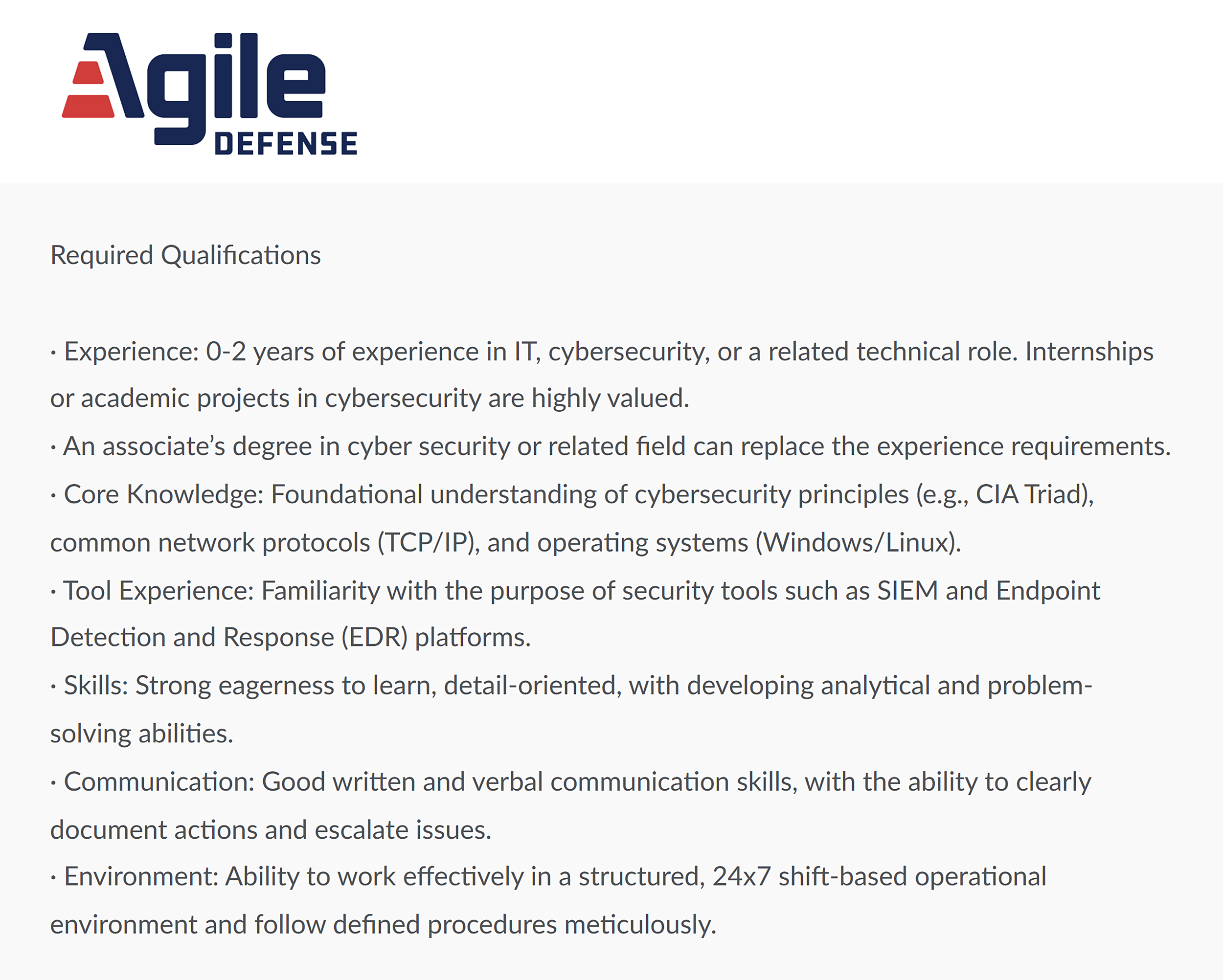
Without an associate degree (or higher) in cybersecurity, your only plausible route into the field would be to secure an extremely basic IT job, before gradually working to transition into cybersecurity roles.
What to Expect From an Online Associate in Cybersecurity Program
A typical cybersecurity associate program is 60 credits, although some require a few more. Rowan-Cabarrus Community College, for example, requires 70-71 credits.
Program length can also vary slightly. Two years is by far the most typical program, but part-time and accelerated options are available. For example, you can earn your associate at Dakota State in 18 months by opting for the accelerated track.
Online associate cybersecurity programs tend to be particularly flexible on timings. They are designed with working professionals in mind.
For example, Southern New Hampshire University bills entirely on a per-credit basis, so full-time and part-time students will pay exactly the same.
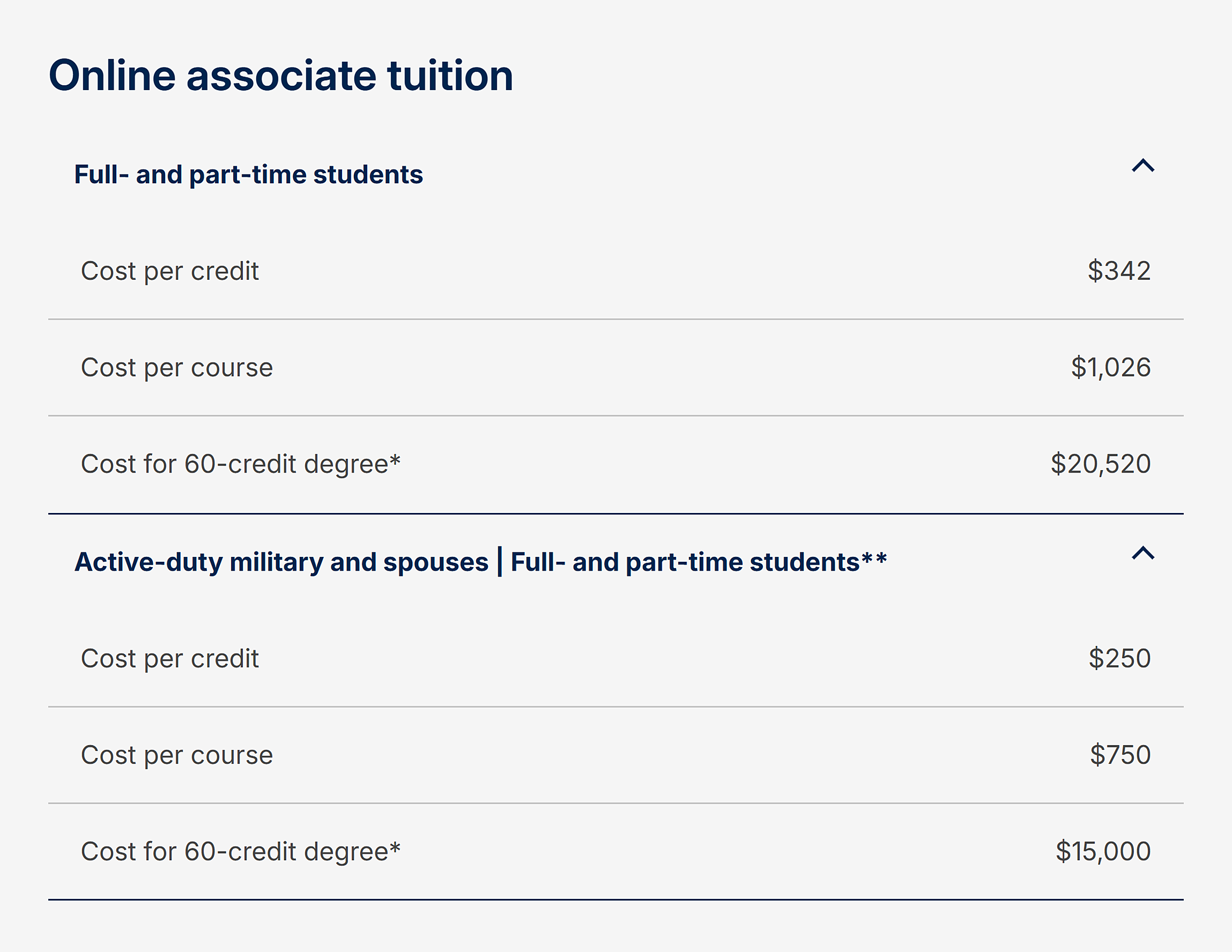
In this case, even the part-time option is designed to let you complete in 2 years. Studying full-time (2 courses per term) allows you to complete the program in 18 months, even without any transfer credits.
A strong associate program in cybersecurity (online or otherwise) is built around practical competence in the field. The most effective programs concentrate on a small set of skills that show up repeatedly in entry-level roles, interviews, and early on-the-job tasks.
Core Technical Foundations
Most programs cover similar subject areas:
Networking fundamentals are central. You’ll spend quite a bit of time learning how networks actually function: IP addressing, subnets, routing concepts, common services, and basic troubleshooting. Employers expect entry-level hires to understand where data flows, what devices are involved, and how misconfigurations can create security issues. This knowledge is often assumed and not taught on the job.
Here’s a description of the Networking Technologies course at Oklahoma City Community College, required as part of the Associate in Applied Science (AAS) in Computer Science – Cyber/Information Security:

Operating systems administration is another cornerstone. Associate programs that treat Windows and Linux as peripheral topics can leave you (as a graduate) at a disadvantage. Entry-level security work frequently involves user accounts, permissions, services, logs, and system behavior. You should expect hands-on experience managing users, understanding privilege boundaries, and observing how systems behave under normal conditions.
The Cybersecurity and Computer Networks program at Bismarck State prescribes courses on Linux Fundamentals, Windows OS, and Linux System Administration:

Security monitoring and controls form the third pillar. Graduates are not expected to investigate incidents independently, but they are expected to recognize and flag when something doesn’t look right. Programs typically introduce logging concepts, alerting, access controls, and basic security tooling. The goal is familiarity with signals and escalation paths rather than mastery of response.
Here’s an Incident Response and Disaster Recovery course outline from the St Petersburg Cybersecurity Associate in Science program:
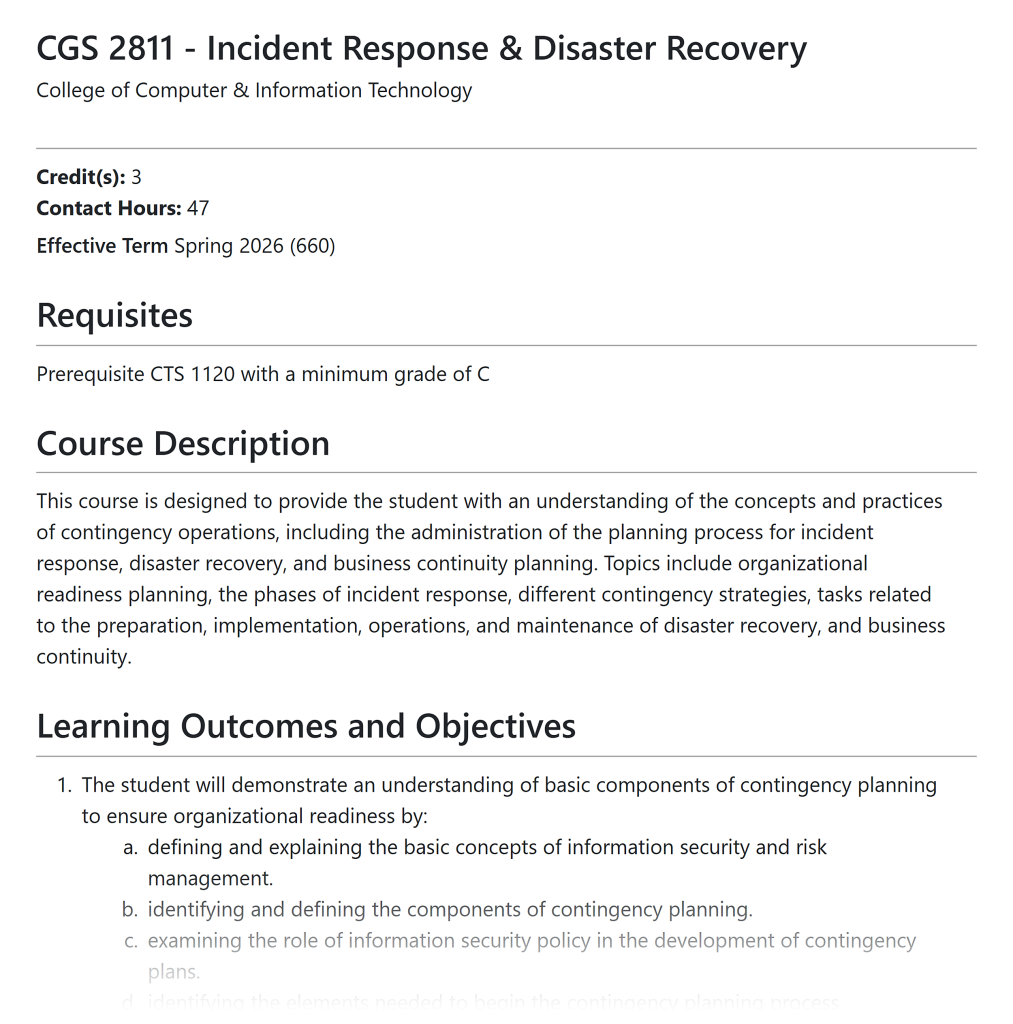
Across these areas, the emphasis should be on understanding systems well enough to avoid causing harm. At this level employers usually prioritize safety, accuracy, and judgment over speed or creative problem solving.
Hands-On Labs and Practical Work
Hands-on labs are the primary source of value in an associate program. Coursework without meaningful labs can make it difficult to get hired for your first job after graduation.
Effective labs focus on routine operational tasks, such as:
- Configuring user accounts and permissions
- Reviewing system and network logs
- Identifying patterns that indicate normal versus abnormal behavior
- Following documented procedures to resolve or escalate issues
These activities mirror what entry-level hires are actually asked to do. Advanced scenarios are less important than repetition and familiarity.
A program like the one at Anne Arundel Community College does this really well. The cyber capstone requirement is designed to mirror real workplace cybersecurity challenges:

Why is this important? Associate degree grads often struggle to explain their reasoning. Interviewers frequently probe how a candidate arrived at a conclusion or why a particular action was taken. Programs that emphasize lab walkthroughs without requiring explanation or troubleshooting can leave you unprepared for this scrutiny.
Topics That Are Often Overemphasized
Many associate programs include content that sounds impressive but provides limited immediate value.
For example: abstract cryptography, high-level ethical hacking surveys, and broad overviews of advanced attack techniques. While these topics have a place later in a cybersecurity career, they rarely influence hiring decisions for associate-level candidates.
Time spent on these areas often displaces deeper practice with networking, operating systems, and monitoring fundamentals. Employers hiring at this level consistently value competence in these basics over exposure to advanced concepts.
Assessment and Evaluation Style
Assessment methods vary widely between programs. Strong programs rely on practical demonstrations of competence rather than heavy reliance on multiple-choice exams.
You should expect to be evaluated on your ability to:
- Complete labs accurately
- Follow procedures
- Demonstrate understanding of cause and effect in systems
Online vs On-Campus: What Actually Changes
Core cybersecurity subjects like networking, operating systems, and basic security concepts adapt well to online learning. The main limitations of online programs show up in areas that depend heavily on live mentorship or real-time interaction, such as incident response drills or team-based red-team exercises.
At the associate level, this gap is usually not a major drawback. Employers are not expecting graduates to arrive with advanced, hands-on response experience. The bigger risks are programs with shallow labs, inflated job promises, or instructors who lack recent industry experience.
Associate Degree vs Certifications vs Bootcamps
For students without prior IT experience, associate degrees generally provide a stronger technical foundation than certifications alone. Certifications help build specific knowledge but assume familiarity with environments.
Bootcamps often emphasize speed and interview readiness but may sacrifice depth.
Associate graduates tend to have stronger fundamentals but may need to work on communication and explanation skills (due to the lack of workplace experience).
The best associate degree programs pair entry-level certifications and continued hands-on experience. Associate programs that align with certifications, or even include them, are therefore worthy of your attention.
For example, Eastern New Mexico University – Ruidoso allows you to sit for CompTIA Security+ and Certified Ethical Hacker as part of the program:

Associate Degree in Cybersecurity: Job Roles and Salary
You won’t graduate your associate degree in cybersecurity as a full-fledged security specialist. That will be apparent in the roles (and salaries) available to you.
Most associate-degree graduates begin in entry-level IT or security-adjacent roles. In the U.S., this generally places starting pay in the $40,000–$65,000 range, depending on location, employer, and prior experience.
Common scenarios include:
- IT Support / Help Desk (Security Exposure)
- Entry-level IT support roles commonly pay $40,000–$55,000. In organizations with mature security programs, these roles may include tasks such as access provisioning, endpoint security checks, phishing ticket triage, or basic incident escalation.
- SOC Tier 1 / Junior SOC Support
- When graduates land true SOC roles, compensation is typically higher, often $50,000–$70,000, with shift work playing a role. These positions focus on monitoring dashboards, reviewing alerts, and escalating issues according to runbooks. Independent investigation is rare at this level, which limits pay growth early on.
- Compliance or GRC Assistant Roles
- Entry-level compliance or governance roles often fall between $50,000–$65,000, particularly in regulated industries such as healthcare, finance, or government contracting. These roles are all about documentation, audits, and policy adherence rather than technical depth, which shapes both pay and career trajectory.
- Junior Systems or Network Technician
- Salaries vary widely, but many fall in the $45,000–$65,000 range. These roles can lead to higher long-term earnings if you continue building technical depth in networking or infrastructure security.
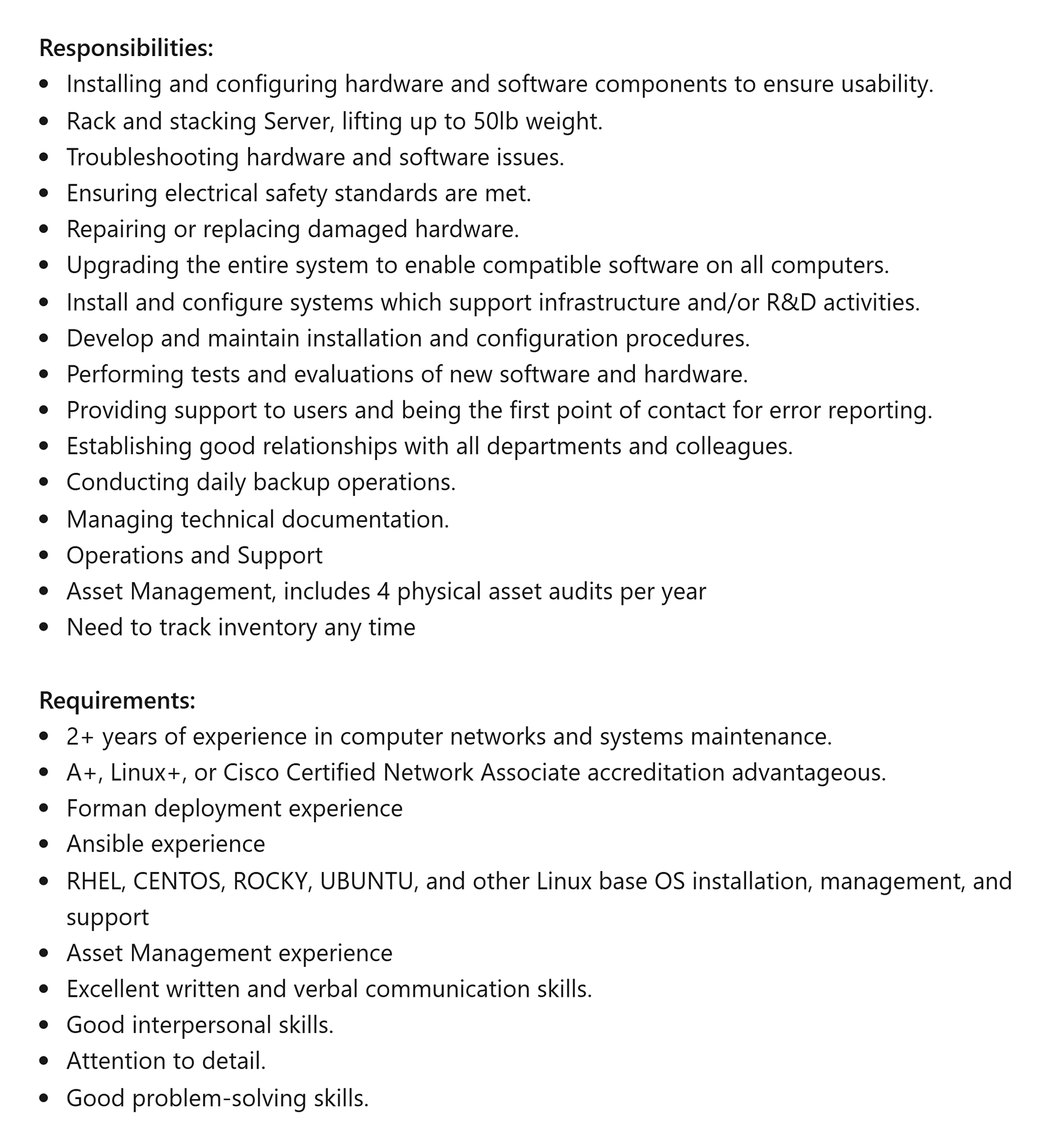
This example from Nexien shows the responsibilities of a typical associate-level IT tech support role. At $60,000, it is relatively well-paid, although it is based in the high-cost California market:
How to Evaluate an Online Cybersecurity Associate Program
When deciding on the best program for you, consider the following:
- Where graduates are employed six to twelve months after completion
- How much time is spent in hands-on labs
- Whether instructors have real industry experience
- How much of the curriculum looks “workplace-ready” (practical skills over high-level concepts)
- What real students are saying (check forums like Reddit)
By completing these simple checks, you should be able to find an online cybersecurity associate program that will both work for you and genuinely mean something to employers.
Rankings Methodology
We analyzed 100+ US-based colleges and universities that offer online associate degrees in cybersecurity.
Specifically, we ranked these programs based on a combination of the following factors:
- Cost/Affordability: Does the program offer in-state rates? How does tuition compare to other programs in the same region?
- Career Outcomes: Does the program provide hands-on experience that cybersecurity employers demand?
- Program Structure and Flexibility: Does the program support part-time enrollment, asynchronous coursework, or accelerated pacing? Programs that allow students to balance school with work or family obligations scored higher than those with fixed timelines.
- Faculty and Instructional Quality: We considered whether courses are taught by faculty with recent industry experience or meaningful applied research backgrounds.
- Institutional Credibility: While not the dominant factor, we also accounted for the school’s overall reputation in technical education, employer familiarity with the institution, and evidence of positive graduate outcomes when available.
Of course, no associate degree is objectively “best” for everyone. At this level, even with online programs, geography is a massive factor: if you can access in-district rates, that should be a major consideration.
The right choice also depends on what you want to work on, how much you can spend, how the program is delivered, and what schools are realistically accessible to you. But this list should be a really helpful starting point.
Top 20 Online Cybersecurity Associate Degree Programs
1
Anne Arundel Community College
Arnold, MD
Overview
- A.A.S. in Information Assurance and Cybersecurity
- Strong Pick For: Defense & Intelligence Hiring; Cost-to-Outcome Ratio
- Credits Required: 61
- CAE Designation: CAE-CD (2Y)
- Cyber Skills: Network Defense; Cyber Operations; Digital Forensics; Incident Response
Program Summary
Anne Arundel offers more customizability than most associate cybersecurity programs. You’ll pick from 3 concentrations: digital forensics, networking, and security. Networking is arguably the best pick for immediate career prospects: you’ll learn hands-on, entry-level skills that feed into roles like system administrator or network manager.
Another point in Anne Arundel’s favor is that it maintains an articulation agreement with the University of Maryland Global Campus. That means you’ll be able to continue seamlessly to a fully-online 4-year program if you so wish (and UMGC ranks in the Programs.com top 10 online cybersecurity bachelor’s programs).
Cost-wise, Anne Arundel comes in under $8,000 for in-county residents. There’s no financial advantage to taking the program fully online, and out-of-state students will pay close to $27,000.
2
Community College of Baltimore County
Balt. County, MD
Overview
- A.A.S. in Cybersecurity
- Strong Pick For: Transfers, Enterprise-Style Training
- Credits Required: 60
- CAE Designation: CAE-CD
- Cyber Skills: Ethical Hacking; Network Defense; Digital Forensics
Program Summary
The Community College of Baltimore County stands out for its “Degrees to Succeed” program. This provides more than credit transferability; it guarantees admission to a number of respected 4-year Maryland colleges, including UMGC and Towson.
Despite being set up for transfers, CCBC actually gets you more workplace-ready than lots of online cybersecurity associate programs. You’ll benefit from training specifically designed to prepare you for entry-level positions: coursework will place you inside simulated networks, where you will practice threat detection and response under realistic conditions. If you decide against “completing” your degree, you should have the skills to go straight into the workplace.
3
Northern Virginia Community College
Annandale, VA
Overview
- A.A.S. in Cybersecurity
- Strong Pick For: Federal Career Tracks; Clearance-Oriented Pathways
- Credits Required: 65
- CAE Designation: CAE-CD
- Cyber Skills: Systems Security; Digital Forensics; Network Defense
Program Summary
If you’re looking for a cheap way to get the first half of your bachelor’s degree, NOVA is probably not the number 1 choice for you. The school specifically reminds applicants that transferring is not the primary purpose of the associate program (although there are transfer pathways in place with respected 4-year Virginia schools like George Mason).
Instead, NOVA excels in giving you the best possible chance of quickly getting onto a federal career track. The benefit of the school’s location is a little watered down when taking the program online, but you’ll still get all the advantages of faculty links to local government agencies. An internship is one of the approved electives in your final semester.
4
Ivy Tech Community College
Indianapolis, IN
Overview
- A.S/A.A.S. in Cybersecurity/Information Assurance
- Strong Pick For: SOC-Oriented Training; Statewide Employer Reach
- Credits Required: 60
- CAE Designation: CAE-CD
- Cyber Skills: Security Operations; Risk Management; Network Defense
Program Summary
Ivy Tech stands out from other entrants on our list because of its scale. It’s actually a state-wide community college system: you can choose from one of 16 locations, as well as the 100% online option. As a result, your associate degree will mean something to just about any employer in the state. Resident rates also apply state-wide, at a reasonable $178 per credit ($348.97 for out-of-state students).
Another interesting thing about Ivy Tech is that it actually offers two associate programs. You can choose to study an A.S, which is specifically designed for people who expect to go on to a bachelor’s program. On average, you’ll save more than $10,000 compared to a traditional 4-year route.
Or you can opt for the A.A.S, which is designed for immediate workplace readiness. You’ll learn the skills required for entry-level IT and SOC roles: there are two required IT Support Essentials courses as part of the Professional-Technical Core, as well as courses in Network Protocol Analysis and Enterprise Computing.
5
Sinclair Community College
Dayton, OH
Overview
- A.A.S. in Cyber Investigation Technology
- Strong Pick For: Extra-Curricular Opportunities; Law Enforcement and Defense Employers
- Credits Required: 61
- CAE Designation: CAE-CD
- Cyber Skills: Digital Forensics; Cyber Defense; Network Security
Program Summary
In some ways, you may be narrowing down your entry-level job options by choosing to study at Sinclair Community College. But if you’re already keen on targeting the law enforcement side of cybersecurity, few community colleges will give you a better foundation. Computer Forensics, Constitutional Law and Evidentiary Procedures, Ethics and Professionalism in Criminal Justice, Computer Crime, and Criminal Justice Science Seminar are all on the curriculum.
You’ll also have the chance to participate in a range of extra-curricular cybersecurity activities. Hackathons and other competitions are a great way of boosting your resume and skills. Budget-wise, Ohio residents pay under $10,000 in total tuition, although that jumps above $20,000 if you’re considering taking the online program from out of state.
6
Oklahoma City Community College
Oklahoma City, OK
Overview
- A.A.S. in Computer Science – Cyber/Information Security
- Strong Pick For: Ultra-Low Cost; Certification-Driven Curriculum
- Credits Required: 61
- CAE Designation: CAE-CD
- Cyber Skills: Security+ Preparation; Network Security; Intrusion Detection
Program Summary
If you’re an Oklahoma resident, you can get your associate in cybersecurity from OCCC for around $6,500 in total tuition. The non-resident rate is fairly reasonable as well, working out just over $18,000 (still a major saving vs the first 2 years of a 4-year program).
The program itself is heavily geared toward industry-recognized certifications. Broadly speaking, this is a sensible approach for an associate in cybersecurity: the combination of an associate degree plus certifications will be enough to make some genuine career advancement without further education. You’ll be required to complete CompTIA A+ preparation training as part of the program, and the Principles of Information Security course maps to CompTIA Security+.
7
Rose State College
Midwest City, OK
Overview
- A.A.S. in Cybersecurity
- Strong Pick For: Defense Contractor Pipelines; Certification Prep
- Credits Required: 66
- CAE Designation: CAE-CD
- Cyber Skills: Incident Response; Network Defense; Digital Forensics
Program Summary
If you choose Rose State, you can be confident of getting high-quality teaching. The college actually provides training to other community college and secondary school faculty throughout the state and beyond, and it has CAE-CD designation too. The college’s Center for Cybersecurity Education has additional recognition from the Air Force Association, National Science Foundation, and the state of Oklahoma.
Once you graduate, you will be in a good position to earn certifications. Dedicated Security+ and Cloud+ preparation courses are included in the program requirements. You’ll also earn some embedded certificates along the way.
In terms of cost, residents pay around $8,500 in total tuition, although that rises above $22,000 for non-residents. When it comes to potential career opportunities, Rose State has close links with Tinker Air Force Base (including a campus there).
8
Coastline College
Fountain Valley, CA
Overview
- A.S. in Cybersecurity
- Strong Pick For: Extreme Affordability; Military & Career Changers
- Credits Required: 60
- CAE Designation: CAE-CD
- Cyber Skills: Network Security; Information Assurance; Security+ Alignment
Program Summary
Coastline College is unbeatable on value. The bottom line is that you can earn your online associate degree in cybersecurity there for less than $3,000 if you’re an in-state resident. Somewhat unfortunately, there’s a $402 per unit surcharge for non-resident tuition, so you’ll pay more than $26,000 total if you’re not in California. But if you are a resident, Coastline is a financial no-brainer.
Its academic credentials also stack up pretty well. Coastline offers an AS rather than an AAS, and perhaps it doesn’t do quite as good a job as some others on our list of really preparing you for the workplace. On the other hand, it offers an impressively broad overview of key cybersecurity topics. And in fairness, there are multiple certification-aligned courses.
Between the price and the fully-online structure, it’s a great option for military personnel and/or career changers. You can take your first step into cybersecurity without any real financial risk.
9
St. Petersburg College
St. Petersburg, FL
Overview
- A.S. in Cybersecurity
- Strong Pick For: Strong Outcomes; Embedded Credentials
- Credits Required: 60
- CAE Designation: CAE-CD
- Cyber Skills: Ethical Hacking; Network Defense; Incident Response
Program Summary
Don’t be fooled by St. Petersburg offering an A.S. as opposed to an A.A.S. The program is intended to prepare you for a career in cybersecurity, and it does a good job of it. Courses align with industry-standard certifications, and you may even be eligible to sit Security+, A+, Certified Ethical Hacker, and/or Cisco Cyber Operations as part of the program. You’ll also complete a required internship.
When you graduate, you’re entering into a strong cybersecurity market. St Petersburg lists average local salaries for a variety of plausible roles; computer network support specialists earn an average of $76,070, which is above the state and national averages. And across all of the college’s Associate in Science programs, there’s a 92% placement rate.
10
Forsyth Technical Community College
Winston-Salem, NC
Overview
- A.A.S. in IT – Cybersecurity
- Strong Pick For: Very Low Cost; SOC-Style Training; Employer-Ready Fundamentals
- Credits Required: 65
- CAE Designation: CAE-CD
- Cyber Skills: Incident Response; Network Security; Ethical Hacking; Forensics
Program Summary
Forsyth is one of the community colleges that really seems to have grasped the purpose of an applied associate degree. Its cybersecurity program is not flashy, but it takes you through all of the basics that employers will want to see you have covered. You could go in with zero specialist knowledge, and get a solid foundational grounding in computers, databases, networks, programming, and security concepts.
In recognition of its role as a provider of breadth more than depth, Forsyth is also super-affordable. North Carolina residents can get their degree for under $5,000 in total tuition, while non-residents will pay around $17,420. That’s great value, particularly considering that you’re still getting CAE-CD designated teaching, at 1 of the 10 colleges nationwide designated as a CAE Regional Resource Center. The fully-online format is also well-suited to working professionals.
11
Rowan-Cabarrus Community College
Salisbury, NC
Overview
- Information Technology A.A.S. in Cybersecurity
- Strong Pick For: Elite Affordability; Workplace-Ready Skills
- Credits Required: 70-71
- CAE Designation: CAE-CD
- Cyber Skills: Incident Response; Risk Management; Network Defense
Program Summary
Rowan-Cabarrus offers a really well-balanced cybersecurity associate program. It’s 10-11 credits longer than your typical program, and it makes full use of that extra room to maneuver. It provides a surprisingly comprehensive dive into the kind of networking skills that will help you land your first job: Introduction to Networks, Switching and Routing, Enterprise Networking, and Network Programmability are all on the first-year curriculum. Later on, you’ll also be introduced to more specialized concepts like ethical hacking and intrusion detection.
And don’t worry: the extra credits don’t really harm affordability. A rate of just $76 per credit hour for state residents means you can still complete the program for under $5,400, or $18,760 for non-residents.
12
Dakota State University
Madison, SD
Overview
- A.S. in Network and Security Administration
- Strong Pick For: “Cyber University” Signaling; Research/Range Access
- Credits Required: 60
- CAE Designation: CAE-CD, CAE-R, CAE-CO
- Cyber Skills: Network Security; Pen Testing Foundations; Cyber Defense Operations
Program Summary
Without a shadow of a doubt, Dakota State is the most specialized cybersecurity school on our list. It’s triple CAE designated: if anything, that’s overkill for your associate degree! But you’ll still benefit from the institutional prestige: employers recognize Dakota State as a genuine leader in the field. And even though you’ll only be covering relative basics, it’s still a clear positive to be taught by real experts, and to have access to elite physical and online cybersecurity facilities.
Dakota State is primarily a 4-year school, so that means an extremely straightforward 4-year completion route. The associate is actually considered the first stage of a dedicated “2+2” program, providing access to one of the best cybersecurity bachelor’s degrees in the country. You can even complete in fewer than 2 years, with the accelerated 18-month program. The one major downside is that there are far more cost-effective ways to earn an associate degree: even in-state, you’re looking at over $17,000.
13
Bismarck State College
Bismarck, ND
Overview
- A.A.S. in Cybersecurity & Computer Networks
- Strong Pick For: Near-Guaranteed Placement; Vendor Partnerships (Palo Alto)
- Credits Required: 60-63
- CAE Designation: CAE-CD
- Cyber Skills: Network Infrastructure; Cloud Defense; Digital Forensics; Incident Response
Program Summary
Bismarck State is great for giving you hands-on, real-world practice. The final 3 required courses are Cybersecurity Career Introduction, Cybersecurity Career Development, and Cybersecurity Career Enhancement, all of which can be replaced by relevant internships.
That has a tangible impact on career outcomes: in the latest available data, Bismarck’s Cybersecurity and Computer Networks program boasted a 100% employment or continuing education rate, with salaries ranging from $40,000-$80,000. (Interestingly, that’s the exact same salary range reported for Bismarck’s bachelor’s program.)
You’ll also benefit from vendor partnerships. Palo Alto has worked closely with the state of North Dakota to invest in cybersecurity education, and that includes a partnership with Bismarck State. But to the college’s credit, the curriculum is still designed to prepare you for the most relevant certifications, rather than only leaning into Palo Alto’s certs: courses align with widely-recognized qualifications from CompTIA, Cisco, and Microsoft.
14
ENMU – Ruidoso Branch CC
Ruidoso, NM
Overview
- A.A.S. in Information Systems Cybersecurity
- Strong Pick For: Extreme Affordability; Embedded Certifications
- Credits Required: 67
- CAE Designation: CAE-CD (2Y)
- Cyber Skills: Security+ / DoD-aligned Fundamentals; Network Security; Defensive Tools
Program Summary
The standout feature of ENMU-Ruidoso’s associate in cybersecurity is that you’ll graduate with CompTIA Security+ and Certified Ethical Hacker. These are undoubtedly two of the most well-respected entry-level certifications in the industry, so to have them included in your associate degree is incredible for your employability.
It’s also great value, considering the program costs just $3,551 for in-district residents. And that’s only half the story: even if you’re out-of-state, you can still complete the program for as little as $8,844. And with no credit hour charges once you exceed 12 in a semester, you can technically get your degree even cheaper if you take on a high workload.
The capstone project is participation in the Cybersecurity Challenge competition, which is designed and run alongside industry partners. That’s great for honing practical skills, and also serves as preparation for National Cyber League competitions (great for resumes).
15
Collin College
McKinney, TX
Overview
- A.A.S. in Information Systems Cybersecurity
- Strong Pick For: Extreme Affordability; Online Support
- Credits Required: 60
- CAE Designation: CAE-CD
- Cyber Skills: Attack/Defense Simulation; Risk Analysis; Security Tooling
Program Summary
The cybersecurity program at Collin has seen significantly increasing popularity in recent years. Enrollment is up from 538 in 2019-20 to over 1700 at the latest count. But growing numbers have not impacted the strong levels of academic support: you can access online tutoring from the Networking Lab by appointment, getting expert guidance on certification-aligned courses including Network+ and Security+ (although the website does note that the tutoring position is currently vacant).
If you’re a Collin County resident, you can earn your associate in cybersecurity at Collin for under $4,000. That rises to $7,500 for Texas residents, and $12,000 for other domestic and international students, but the bottom line is that tuition is affordable for all.
You should also consider the effect of articulation/transfer agreements. You can apply from Collin for pre-admission at a number of prestigious Texas institutions, including Baylor and the University of Texas at Dallas. If accepted, you may get access to benefits like library use, university advisors, and fee waivers.
16
San Antonio College
San Antonio, TX
Overview
- A.A.S. in Information Assurance and Cybersecurity
- Strong Pick For: “Cyber City USA” Hiring Density; Federal Internships
- Credits Required: 60
- CAE Designation: CAE-CD (2Y)
- Cyber Skills: Network Defense; Forensics; Security Operations; Policy Basics
Program Summary
San Antonio College benefits from an unusually concentrated cybersecurity labor market. San Antonio is anchored by major military cyber operations and a large network of contractors and security firms, and is second only to Washington, DC for the concentration of cybersecurity workers.
In other words, the city’s economy naturally creates a steady appetite for entry-level talent. And SAC has built an associate degree that can function as your local access badge into federal internships and early-career roles. The curriculum is laser-focused on the skills you’ll need in early cybersecurity employment: you’ll cover IT security, intrusion detection, incident response, computer system forensics, Linux configuration, and more.
17
Wake Technical Community College
Raleigh, NC
Overview
- A.A.S. in Cybersecurity
- Strong Pick For: Extreme Affordability; Certification Alignment, Graduate Outcomes
- Credits Required: 69
- CAE Designation: None (CAE-CD expired 2025)
- Cyber Skills: Network Security; Security Operations; Compliance/Auditing Basics
Program Summary
Wake Tech is one of the community colleges that really stands out for its affordability. In-state tuition comes to a total of $5,244. If you’re out-of-state, you’ll still pay under $18,500.
With the savings, you’ll be able to sit for lots of relevant cybersecurity certifications. The curriculum is designed to prepare you for CEH, Security+, ISC2 Certified in Cybersecurity and more. And you’ll get hands-on practice, not just theory: almost all courses are at least 50% labs.
Proximity to the Research Triangle means you have a good chance of finding employment. Nationwide, Wake Tech is among the top 20% of colleges and universities for graduate ROI after 10 years, and 90% of graduates are in work or education after 1 year.
18
Spokane Falls Community College
Spokane, WA
Overview
- A.A.S. in Information Technology – Cybersecurity Emphasis
- Strong Pick For: SOC Emphasis
- Credits Required: 85-90 (quarter system)
- CAE Designation: CAE-CD
- Cyber Skills: Security Controls; Investigation Techniques, Network Security
Program Summary
There are actually two cybersecurity associate degrees at Spokane Falls. One designates you as a “Cyber Defender”, while the other qualifies you as a “Cybersecurity Operation Center Analyst”. That title is a good indicator that the curriculum is focused on getting you into a realistic entry-level cybersecurity role. You’ll cover all of the basics needed for a Tier 1 SOC Analyst position.
Unlike most community colleges, you can also go on to earn a bachelor’s degree at SFCC. This is an extremely affordable route compared to traditional 4-year colleges, although you obviously won’t benefit from any great institutional prestige.
19
Fox Valley Technical College
Appleton, WI
Overview
- A.A.S. in IT – Cybersecurity Specialist
- Strong Pick For: Workforce-First Training
- Credits Required: 61
- CAE Status: None
- Cyber Skills: SOC Operations; Threat Analysis; Incident Response; Continuity
Program Summary
Fox Valley Technical College is a great program for equipping you with hands-on entry-level cybersecurity skills. The program outcomes are refreshingly practical: conduct security testing, analyze security data, develop security documentation, identify security strategies, implement secure infrastructures, and mitigate risk. When you start looking at job listings for roles like Tier 1 SOC Analyst, you’ll see how closely this aligns.
The workforce emphasis in Fox Valley’s training is shown in the graduate outcomes. From an admittedly small sample size (30 graduates, 12 respondents), 100% of the class of 2023/24 were employed within 6 months of graduation, with 64% in program-related employment. The average salary was $41,741, around $8,000 higher than a typical Wisconsin high school graduate salary.
One drawback is the lack of CAE designation. But courses at Fox Valley do still align with industry standards, including preparation for the Cisco CCNA exam. And you’ll have plenty of hands-on virtual labs to hone your practical skills.
20
Community College of Allegheny County
Pittsburgh, PA
Overview
- A.S. in Cybersecurity & IT Support
- Strong Pick For: Entry-Level Career Readiness
- Credits Required: 60
- CAE Designation: CAE-CD
- Cyber Skills: Network Security; Forensics; Secure Programming Foundations
Program Summary
Allegheny County’s associate program isn’t technically an AAS, but it actually boasts one of the most applied curriculums on our list. It helps that it is unashamedly a cybersecurity and IT support program: you won’t be spending your time on abstract cybersecurity concepts, you’ll just be covering what might be expected of an entry-level position.
You’ll take courses in Help Desk and User Support, Computer Configuration, and IT fundamentals. These probably aren’t your long-term career goals, but they will maximize your chances of at least getting a foot in the door. And you’ll still cover things like ethical hacking, mobile and cloud security, and network routing.
All in all, the total tuition cost of $7,800 is a great investment for in-county residents. This doubles for other Pennsylvania residents, and triples for out-of-state students, so Allegheny County is only a standout choice locally.