The number of data centers in the U.S. is skyrocketing.
Calculating the specific number of data centers is difficult. In part, that’s because there are many different types of data centers, from small rooms with a few servers to massive campuses covering millions of square feet.
It’s also because data center projects are being proposed, approved, delayed, and blocked at unprecedented rates.
Here, we compile the latest, most thorough accounts of the number of data centers in the U.S.
Editor’s Picks
- The U.S. is home to 4,767 data centers, 38.9% of the global total.
- 15 of the world’s largest 20 markets for hyperscale data centers are in the U.S.
- 87% of operating data centers are in urban areas, and 67% of planned data centers are in rural areas.
- 38% of Americans live within 5 miles of at least one operating data center.
- Data centers account for 4.7% of U.S. electricity consumption.
- They could account for up to 15.3% of total electricity consumption by 2030.
- Data centers increase local household income by 2% and employment by 3.5%.
- But they can also cause local electricity prices to rise by 5%.
- 38 states offer tax incentives for data centers, while 46 have adopted local or statewide moratoriums on data centers.
Number of Data Centers in the U.S.
There are 4,767 data centers in the U.S. (Data Center Map)
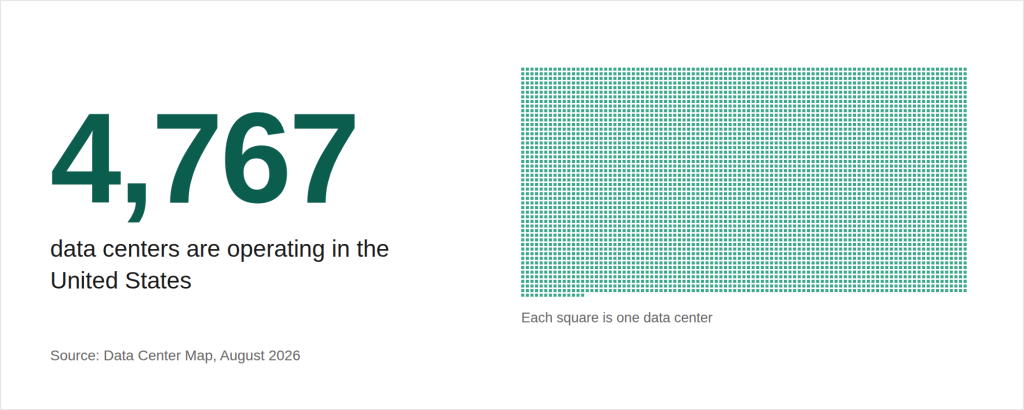
According to the latest data, there are 4,767 data centers operating in the United States as of August 2026.
Data Center Map was one of the first national databases of data centers. According to its research, the U.S. accounts for 38.9% of data centers globally. There are more data centers in the U.S. than in the next nine countries with the most data centers, combined.
Estimates of U.S. data centers range from 1,375 to 8,269 (Several Sources)
Other authoritative sources provide the following figures for U.S. data centers:
- Cleanview: 1,375
- Electric Choice: 2,016
- Apollo Global Management: 4,000
- Statista: 4,767
- U.S. Data Center Map: 4,771
- NTIA: 5,000+
- Cargoson: 5,427
- Aterio: 8,269
Researchers must decide which kinds of data centers to include in their figure.
Cleanview’s estimate of 1,375 refers specifically to operating data centers; it tracks another 2,765 that are planned.
Aterio tracks 2,124 operational data centers, while its wider figure includes 4,380 that have been announced, 861 under construction, and various others that have been delayed or not yet approved.
U.S. Data Center Map’s 4,771 figure includes 3,172 operational, 1,199 planned or approved, and 400 under construction.
Electric Choice’s figure refers specifically to “commercially significant” data centers, and does not include another 570+ that are planned.
Apollo’s figure is for existing data centers, and does not include roughly 3,000 more that are announced or under construction.
There are 1.4 million small or midsize data centers in the U.S. (Science Direct)
The conversation around data centers largely focuses on large projects. Definitions of data centers often have minimum size requirements. But there are many small private server rooms, telecom closets, and similar constructions that could technically be considered data centers.
This study estimated there were 1.398 million such small/midsize data centers across the U.S. in 2018. That’s a significant decrease from 2012, when there were 1.764 million. If that trend continued, there could now be fewer than 1 million small data centers.
The total capacity of operating U.S. data centers is 63,452 MW (Cleanview)
That’s enough power to meet the annual electricity demands of 5.08 million U.S. households.
54% of the world’s hyperscale data center capacity is in the U.S. (Synergy Research)
Capacity here is defined as “MW of critical IT load.” According to this research, the total capacity of operational hyperscale data centers worldwide doubled from 2020 to 2024, and will double again before 2028.
The U.S. has 15 of the world’s 20 largest markets for hyperscale data centers (Techradar)
20 individual markets account for 60% of global hyperscale capacity. 15 of them are in the U.S., 4 in Asia-Pacific, and 1 in Europe. Northern Virginia is the world’s single largest market, accounting for 12% of global hyperscale capacity.
62% of hyperscale data center operators have headquarters in the U.S. (Techradar)
America’s dominance in the hyperscale data space becomes even more apparent when you look at where operators are based.
There are 403 unique data center developers with projects in the U.S. (Cleanview)
The largest developers are tech giants like Amazon, Microsoft, Meta, and Google. But they are just a few of the hundreds of data center developers working on projects in the U.S.
Private firms invested $171.69 billion constructing data centers in Q1 2026 (Federal Reserve)
In the same time frame, private nonresidential investment in computers and peripheral equipment reached $384.18 billion.
Spending on data center construction and the equipment required to run data centers has skyrocketed. In Q1 2021, less than $29 billion was spent constructing data centers, and $143.71 billion on computers and peripheral equipment.
The largest data center in the U.S. is Colossus 2 (Cleanview)
Colossus 2, developed by xAI, began operations in 2026. It sits on 100 acres of land in Tennessee. The building covers some 1 million square feet.
Its capacity is 1,563 MW. That’s more than double the second-largest data center in the U.S., and more than five times the capacity of Colossus 1, which became operational in 2025.
Where Data Centers in the U.S. Are Located
Two-thirds of data centers are in areas with high water stress (ICEF)
Water consumption of data centers for cooling is a major concern, particularly as the majority are located in areas already under significant water stress. Hyperscale data centers are projected to consume up to 33 billion gallons of water per year by 2028.
87% of operational data centers are in urban areas (Pew Research)
Almost all operational data centers are in urban areas. Shorter physical distances to customers means lower latency and higher stability of services. Data centers can also benefit from existing networks for telecommunications, power, and water.
But 67% of planned data centers are in rural areas (Pew Research)
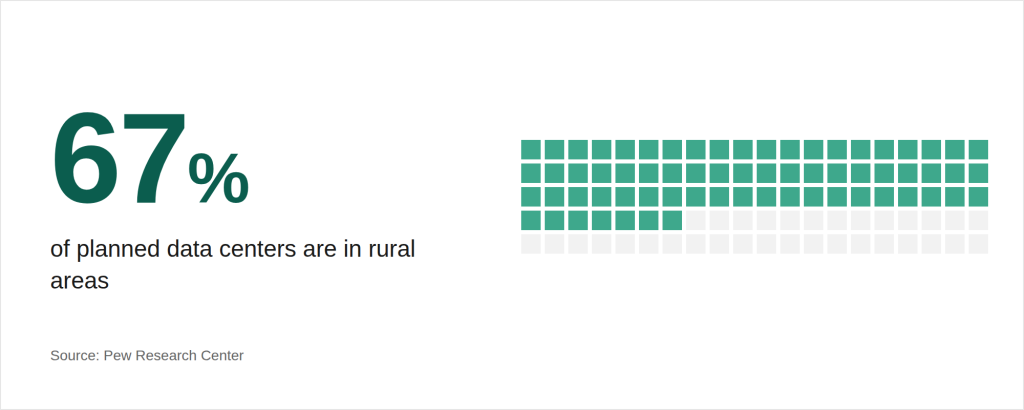
As data centers become increasingly large, and opposition to their construction grows, it becomes more difficult to build them in or near urban areas. So manufacturers are turning to rural America, instead.
42% of Americans live near an operational or planned data center (Pew Research)
38% of Americans live within 5 miles of at least one operational data center, and another 4% live within 5 miles of a planned data center.
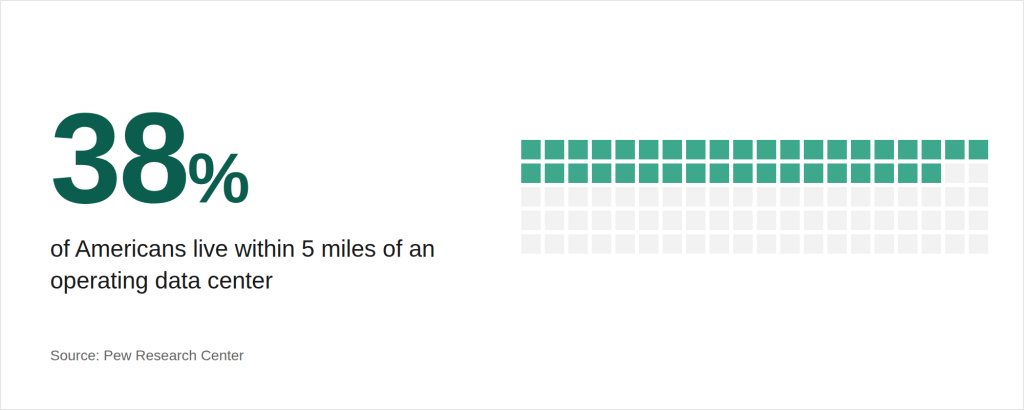
Because data centers are often clustered, most Americans who live near one data center also live near another.
90% of U.S. data centers are within 5 miles of another (Pew Research)
Many data centers are located in clusters. For example, northern Virginia is home to “data center alley.”
More than 40% of data centers are located in areas with high environmental justice burdens (Ryan Kmetz)
This analysis is based on the Centers for Disease Control and Prevention’s Environmental Justice Index framework. It was calculated using a dataset of 706 data centers across the country.
The figure suggests that data centers are not disproportionately located in communities with higher burdens. However, data centers in some regions, like the Western U.S., are disproportionately located in overly burdened communities.
Effect of Data Centers in the U.S.
Data centers account for 4.7% of U.S. electricity consumption (Energy Technologies Area, Berkeley Lab)
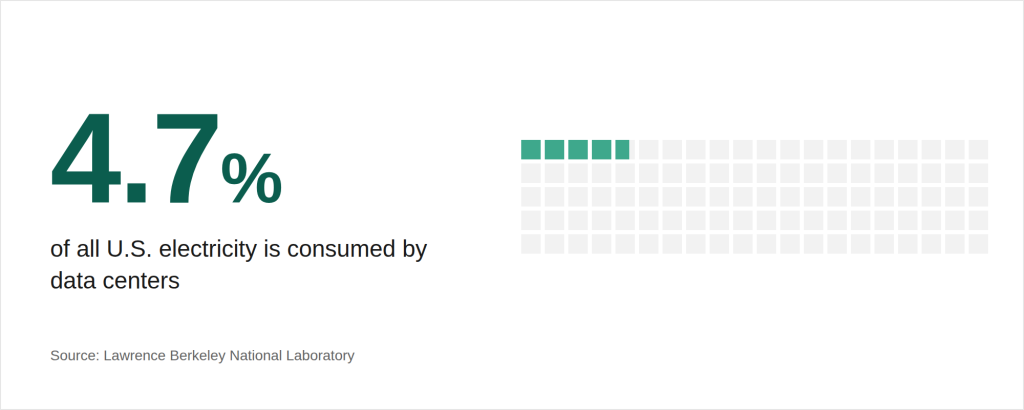
Data centers used an estimated 192 TWh in 2024. For comparison, data centers accounted for 22% of Ireland’s electricity consumption, and 1% of China’s electricity consumption, the same year.
The burden of electricity consumption isn’t spread equally across the country. In Virginia, the state with the most data centers in the U.S., data centers accounted for 25% of total energy demand. In Santa Clara, California, Silicon Valley data centers accounted for 60% of electricity use.
The average operational U.S. data center draws 30-60 MW power (Grid Strategies)
For context, 60 MW is equal to the annual electricity needs of roughly 48,000 U.S. households.
Data centers account for 4.2% of carbon emissions from the U.S. power sector (LBNL via ICEF)
According to research by Lawrence Berkeley National Laboratory, data centers accounted for 61 billion kilograms in CO2 equivalents in 2023. A “CO2 equivalent,” or CO2e, is a unit of measurement used to quantify global warming impact.
Data centers increase household income in host counties by 2% (Georgia Tech)
Researchers found that data centers provide a noticeable economic uplift. On average, when a data center opens, employment rises by 3.5%, wages by 5%, and household income by 2%.
There’s an important distinction, though. Rural areas experienced none of these measurable gains from new data centers. In large part, that’s because urban areas with established labor markets and business networks are better able to absorb the increased demand from a data center.
Data centers can cause local electricity prices to rise by 5% (Georgia Tech)
Who exactly pays for that increased cost varies from place to place, based on policies of local utility companies.
Data centers create 1,000-5,000 construction jobs (Brookings)
Constructing data centers requires a lot of work, and therefore jobs. This range is based on five separate studies. The number of jobs created varies based on factors like the project’s size and location.
These construction jobs aren’t permanent. They end when the data center is completed. But these same five studies also found that data centers create dozens or hundreds of longer-term operational jobs, too.
The average data center creates 100-200 operational jobs (Brookings)
The employment effects of a data center depend heavily on what kind of data center it is. Hyperscale data centers, like those built by AI companies, cause an increase in data processing and telecommunications jobs. Co-location data centers, built by landlords who lease space to remote tenants, increase data processing jobs but decrease telecommunications jobs.
Incentives (like tax breaks) account for 62% of investment in co-location facilities, compared to 2% of investment in hyperscale facilities. In other words, subsidies seem to matter more for facilities that tend to generate fewer measurable employment benefits.
Loudoun County, Virginia, generated 38% of its tax revenue from data centers (Loudoun Now via NTU)
Loudoun County, located in Virginia’s “data center alley,” is one of the world’s major data center hubs. It expects to generate $1.3 billion in 2026 by taxing computer equipment inside data centers. That represents about 40% of its total tax revenue.
These revenues from data centers have allowed the County to drop property taxes for residents by 30% since 2015.
Data centers may cause home prices to rise 2-5% (Brookings)
According to this study, data centers have no measurable effect on wages. But they do affect home prices.
Growth in Data Centers in the U.S.
The electricity demand of data centers has tripled in the past decade (Electric Choice)
Data centers accounted for 58 TWh in 2014. That rose to 176 in 2024.
Data center energy consumption will grow by 29% in 2026 (Energy Technologies Area, Berkeley Lab)
As the number (and size) of data centers increase, they collectively require more power to function. From 2023 – 2024, the collective energy consumption of data centers grew by 14%. The next year it grew by 22%. Through 2030, the compound annual growth rate of energy consumption is projected to be 21%.
The average size of proposed U.S. data centers doubled between 2023-2024 (Grid Strategies)
The size increased from 150 MW to 300 MW.
But the average cost of land bought for data centers decreased by $39,000 per acre (Cushman Wakefield)
Data center operators paid $244,000 per acre, on average, for land in 2024. ($5.59 per square foot.) That’s $39,000 less per acre than in 2023.
However, the average cost of land for large data centers, defined as land parcels of at least 50 acres, increased by 23% over the same time period.
38 states offer tax incentives for data centers (NCSL)
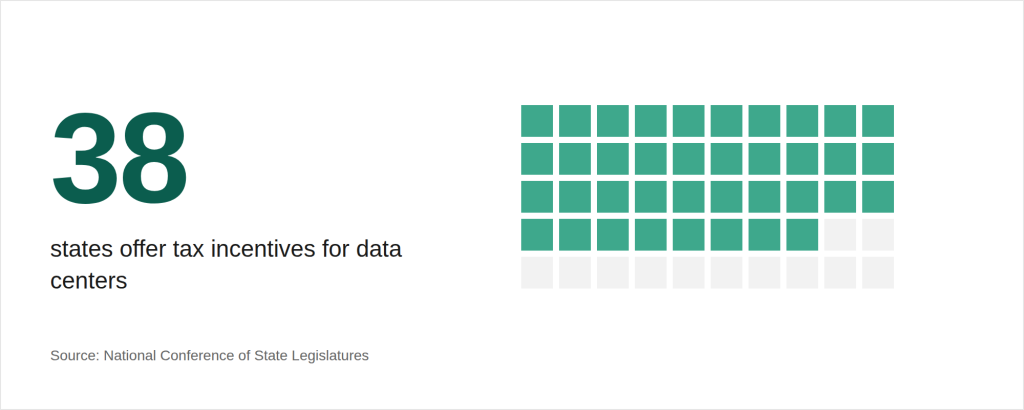
Examples include exemptions on sales tax for computer parts and abatements on property tax.
31 of those states require a minimum capital investment to receive tax incentives. 9 consider geographic factors, making their incentives dependent on factors like the population of an area.
23 states require data centers to create jobs in order to receive tax incentives (NCSL)
Those requirements vary widely. In Maryland, data centers must create 5 new jobs. In Massachusetts, they must create 100. 11 states state those new jobs must pay well.
Coordinated opposition blocked over $64 billion in data centers from 2023-2025 (ICEF)
$18 billion was blocked outright, and another $46 billion delayed. There are at least 142 activist groups across 24 states organizing against data centers.
At least 48 data center projects were stalled or blocked in 2025 (New York Times)
This is a higher estimate of the impact of data center opposition. These projects were collectively worth $156 billion, according to the NYT. They were stalled amid coordinated local opposition.
The amount of new data center capacity under construction in America’s largest markets decreased in the second half of 2025 (CBRE)
This is the first time data center construction has slowed since 2020. The research firm attributed the slowdown to “permitting, zoning and power procurement hurdles.”
Components of U.S. Data Centers
HDDs account for more than 80% of U.S. data center storage capacity (ICEF)
Hard disk drives have a few advantages over other storage options, like solid-state drives. In particular, they draw less power per unit of storage capacity, making them more energy efficient, albeit slower.
AI servers will account for 55% of data center energy use by 2030 (Energy Technologies Area, Berkeley Lab)
AI servers will account for 84% of total server energy use, and 55% of total data center energy use, by the end of the decade.
AI consumed 10-20% of U.S. data center energy in 2024 (Congressional Research Service)
GenAI is responsible for much of the recent growth in data centers. One study found that training a single new large AI model required 25.3 MW, enough to power more than 20,000 U.S. households. Another study found the training process took 50 GW, enough to power the entire city of San Francisco for three days.
There are 30.9 million servers installed across the U.S. (Energy Technologies Area, Berkeley Lab)
Servers are crucial for data centers. 4.2 million of those installed servers are accelerated.
More than 1.5 million accelerated servers were shipped to the U.S. in 2024 (Energy Technologies Area, Berkeley Lab)
Accelerated servers are key to AI data centers. By 2030, that figure is projected to grow to 4.4 million. The share of those servers with 2 GPUs is projected to decline from 27% in 2024 to 9% in 2030, while the share of 8-GPU servers will grow from 37% to 55% of accelerated servers shipped.
The average lifetime of an accelerated server is 5 years (Energy Technologies Area, Berkeley Lab)
That’s a little shorter than non-accelerated servers, which have an average lifetime of 5.7 years.
Future of Data Centers in the U.S.
Demand for data centers is projected to grow 9% every year through 2030 (NTIA)
Much of that growth is to meet the growing demand for AI.
Data centers will account for up to 15.3% of total U.S. electricity by 2030 (Energy Technologies Area, Berkeley Lab)
According to research from ETA, which is linked to the U.S. Department of Energy, data centers will soon account for 9.5 – 15.3% of total U.S. electricity demand. That’s a significant increase from the group’s previous estimate, which was 6.7 – 12%.
The total capacity of operational and planned U.S. data centers is 486,925 MW (Cleanview)
That would be enough to meet the annual electricity demand of 39.0 million U.S. households, or roughly one-quarter of total U.S. households.
16 large-scale data centers are scheduled to come online in 2026/27 (Grid Strategies)
Together, these 16 data centers will add nearly 30 GW of power demand to the U.S. grid. Half of these projects have already begun construction.
For context, Synergy Research Group estimates that 130-140 new hyperscale data centers will come online every year around the world.
Local authorities introduced 294 data center moratoriums in the first half of 2026 (Programs.com)
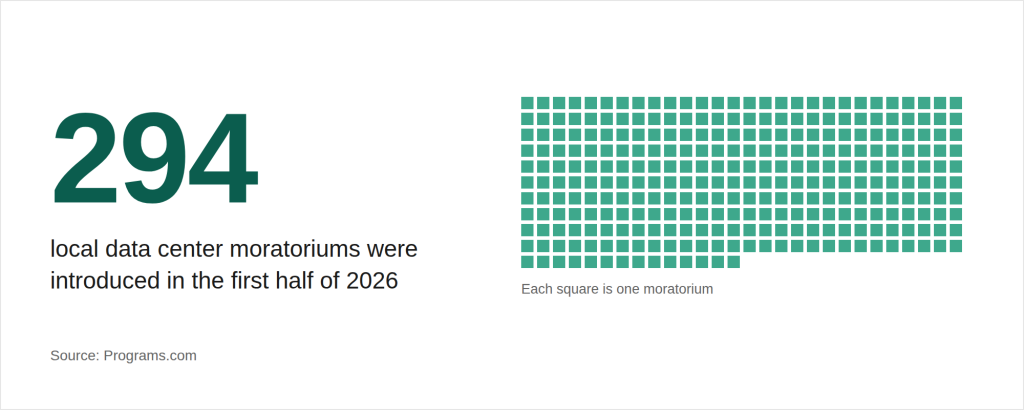
That’s more than four times the number of moratoriums adopted in 2025. Just four states lack any kind of moratoriums on data centers at the local or state level.
16 states have considered or are considering banning data centers (NCSL)
So far, at least 7 of these proposed bans have been vetoed by state governors or failed in state legislatures. New York became the first state to impose a ban on data centers in July, 2026. Gov. Kathy Hochul banned new hyperscale data centers for up to one year.
The number of shipped servers will increase by 80% from 2024 to 2030 (Energy Technologies Area, Berkeley Lab)
5.9 million servers were shipped in 2024. That’s projected to increase to 9.1 million in 2028 and 10.6 million in 2030.
There will be at least 16 million AI servers in data centers by 2030 (Energy Technologies Area, Berkeley Lab)
The number of servers dedicated to AI is projected to significantly increase. This is the lower estimate these researchers provided; their higher estimation is 19.5 million AI servers by 2030.
The largest planned data center in the U.S. is the Delta Gigasite Expansion (Cleanview)
This massive data center, which is being developed by Creekstone Energy in Utah, would have a capacity of 9,700 MW. That’s more than double the collective capacity of the 10 largest operational data centers in the U.S.